
UC San Diego’s 2025 admissions report exposes how dropping the SAT/ACT led to unprepared students and grade inflation—and why a return may be coming.

When should your student start preparing for the SAT or ACT?
Starting too early leads to burnout. Starting too late means missed opportunities.
In this video, Nick Standlea, CEO of Test Prep Gurus, breaks down the sweet spot for test prep success — explaining when to start, what to do first, and how the right timing can lead to higher scores and major scholarship wins.
📘 In this video, you’ll learn:
*Why freshman year is too early to start SAT/ACT prep
*The surprising link between reading for fun and higher scores
*Why waiting until senior year is a costly mistake
*The perfect test prep timeline for 10th and 11th graders
*Real stories of students who gained (or lost) thousands in scholarships because of timing
🎯 Key takeaway:
The best time to start SAT or ACT prep is at the end of sophomore year. Test both, choose your best fit, and plan ahead.
💡 Free Practice Tests:
Take a free SAT or ACT diagnostic with Test Prep Gurus → https://www.prepgurus.com
🎓 Join our next free webinar:
https://www.prepgurus.com
📺 Subscribe for weekly college admission tips:
https://www.youtube.com/@UCls8d42ESvEOO0GrjR0dGWw
⏱️ Timestamps:
0:00 – When Should You Start Test Prep?
0:20 – Why Freshman Year Is Too Early
0:56 – The Power of Reading for Pleasure
1:29 – Why Senior Year Is Too Late
1:48 – The Sweet Spot: End of 10th Grade
2:08 – The Smart Strategy: Test Both, Then Choose
2:35 – Planning Ahead for Junior Year
2:49 – Two Real Student Stories
3:29 – The Final Answer: End of 10th Grade
3:46 – Why Planning Ahead Pays Off

Here’s what UC’s quiet policy review means for your student—and why preparing now is the smartest move you can make.
After four years of test-free admissions, the University of California’s Board of Admissions (BOARS) has begun formally re-examining whether standardized tests should return.
That word—re-examining—may not sound dramatic. But in higher-education policy, it’s almost always the first step toward change.
“Examining an issue” is higher-ed language for “we’re getting ready to make a move.”
Three forces are converging behind the scenes:
Grade inflation and inconsistency across high schools make it hard for UC admissions officers to compare applicants fairly.
Federal pressure: a February 2025 U.S. Department of Education memo warned that eliminating tests to shape diversity outcomes could violate civil-rights law.
National trends: many elite universities that dropped tests during COVID have quietly reinstated them after finding scores improved accuracy and fairness.
The list keeps growing—and it includes some of the nation’s most respected names:
✅ MIT
✅ Yale
✅ Brown
✅ Dartmouth
✅ Princeton
✅ Cornell (some but not all programs)
✅ Caltech
✅ University of Texas at Austin
✅ Rice University
✅ Georgia Tech
✅ Georgetown
✅ Purdue
✅ Service Academies (including United States Naval Academy)
✅ University of Tennessee
Even at schools that remain test-optional, students who submit strong scores are admitted at significantly higher rates.
A high test score has become a major differentiator again—especially for ambitious students aiming at selective programs.
Officially, the UC system was required to remain test-free through Spring 2025 under a lawsuit settlement. And that’s exactly when the Academic Senate’s subcommittee began reviewing the UC testing policy.
Based on past UC timelines:
2026: possible policy update or announcement
2026–2027: potential test-optional pilot period
2028 and beyond: possible test-required return, depending on data and politics
Even if UC stops short of a full mandate, an optional or hybrid model is the logical next step.
Keep Every College Door Open
Whether UC stays test-free or pivots back to test-optional, your student’s best move is to be ready.
📅 Schedule a Free SAT/ACT Strategy Chat →
If your student is applying to UC—or any selective college—preparing for standardized tests remains the smartest long-term strategy.
Future-proof your plan. If UC reinstates testing, you’ll already be ahead.
Stand out everywhere else. At nearly all top schools, strong scores still help—often dramatically.
Unlock scholarships. Many merit and honors programs still rely on test scores.
Strong test scores can only help you. They open doors—never close them.
UC hasn’t brought back the SAT or ACT yet, but the signs are clear: this is the first step in the process.
Universities rarely use the word “examine” unless they’re preparing to move.
So don’t wait for the official announcement. Start preparing now, and your student will be ready no matter what happens next.
Ready to give your student every advantage?
👉 Book a free consultation with Test Prep Gurus today.
Getting into college doesn’t have to feel overwhelming. The process becomes much clearer when you understand what matters most at each stage of high school.
This playlist, hosted by Nick Standlea, CEO of Test Prep Gurus, walks parents through the journey step by step — from freshman year all the way to senior year — so you always know what’s coming next and how to best support your student.
👉 Video 1: 9th & 10th Grade Preview
Learn how freshmen and sophomores can build the foundation for success. We’ll cover GPA, reading/writing and math fundamentals, exploring activities, mindset, and the PSAT 10 for sophomores.
👉 Video 2: 11th Grade Roadmap
Junior year is the most important year. We’ll cover the PSAT, SAT vs ACT decisions, testing timelines, Score Choice and Superscoring, GPA focus, extracurricular leadership, and starting the college list.
👉 Video 3: 12th Grade To-Do List
Senior year is about deadlines and execution. We’ll explain last-chance testing dates for Early Action and Regular Decision, how to register strategically, and how scores can unlock both admissions opportunities and scholarships.
Together, these videos form a complete College Admissions Roadmap for Parents — giving you clarity, confidence, and a clear action plan from 9th grade through 12th.
When most people hear the name Howard Gardner, they immediately think of Multiple Intelligences Theory—the groundbreaking framework that reshaped how teachers and parents understand student strengths. But Gardner’s influence goes far beyond the classroom. In a recent conversation with Nick Standlea on The Nick Standlea Show, Gardner offered candid insights into how artificial intelligence is reshaping higher education and what this means for the next generation of students.
The college landscape is shifting rapidly. From test-optional admissions to the explosion of AI tools like ChatGPT, families are left wondering: What skills will truly matter in the future? Gardner argues that while AI may automate many traditional academic tasks, the uniquely human qualities—creativity, ethical reasoning, adaptability—will only grow more valuable.
For students preparing for college, that means learning how to:
Adapt quickly to new technologies and expectations
Think critically about information in an AI-driven world
Develop authentic strengths that can’t be outsourced to machines
Gardner pointed out that colleges face a double challenge: integrating AI into teaching and research, while also helping students navigate the ethical dilemmas it creates. Will essays still be the measure of a student’s thinking? How should professors approach assessment when AI can generate polished work in seconds?
The future Gardner envisions is not about eliminating testing or coursework, but about reframing them as feedback loops—ways for students to understand their progress, adapt, and grow. This echoes our own philosophy at Test Prep Gurus: testing should never be about judgment, but about information that guides better learning.
AI won’t replace effort. Students who build strong habits of deep learning and resilience will stand out.
Test scores still matter. While many colleges remain test-optional, data consistently shows that students who submit strong scores are admitted at higher rates.
Adaptability is the new gold. Whether in college admissions or in the workplace, the students who thrive will be those who see change not as a threat, but as feedback to learn from.
Howard Gardner has spent a lifetime studying how humans learn and grow. His message now is clear: the future belongs to students who can combine adaptability with authenticity. At Test Prep Gurus, we’re proud to help students not only raise their test scores, but also develop the growth mindset and learning strategies that will serve them in the age of AI—and beyond.

Let’s get one thing straight:
The SAT doesn’t measure your intelligence.
It doesn’t measure your potential.
And it definitely doesn’t measure your worth as a person.
So what does it measure?
How well you understand and apply academic skills in reading, writing, and math
How efficiently you solve problems under time pressure
How effectively you’ve prepared using targeted strategies
That’s it.
It’s not about brilliance. It’s about skill, practice, and mindset.
Let me give you a metaphor I often share with students:
The SAT is like learning to play a piece of music on the piano.
If your first few practice sessions are full of wrong notes or awkward timing, that doesn’t mean you’re doomed. It just means you’re still learning the piece.
No one is born a concert pianist. They become one by practicing the same tricky measures, building muscle memory, and making small corrections until it clicks.
The SAT is your sheet music.
Prep is your rehearsal.
And if you keep showing up with focus, effort, and feedback, that jumble of notes?
It starts to sound smooth. Then beautiful.
And eventually, you play it with confidence—maybe even joy.
The SAT is a timed obstacle course.
You’re not being graded on your identity—you’re being tested on how well you navigate a specific set of challenges.
Every time you run the course, you get faster.
You learn the layout.
You stop tripping over the same hurdles.
Your score reflects your readiness—not your value.
And readiness?
That can be trained.
No matter where you’re starting from, your SAT journey isn’t about proving who you are.
It’s about building who you want to become.
And that’s what we do at Test Prep Gurus:
Help students train for the course, refine their technique, and hit their stride.
Want to get started?
Schedule a call with our team today.
In this heartfelt and insightful interview, Test Prep Gurus founder Nick Standlea sits down with Greg McCullen, Director of Business Relations at the Orange County School of the Arts (OCSA), to talk about parenting, education, identity, and growth.
Greg opens up about the emotional journey of sending his son Lucas—an empathetic, passionate dancer with ADHD—off to college. He shares how Lucas overcame test anxiety with the help of a personalized test prep approach at Test Prep Gurus, raising his ACT score by 13 points and earning a spot on a top university’s dance program.
Greg also shares the story of his daughter Kate, a former competitive gymnast turned aspiring attorney and climate advocate. From elite arts training to international academic programs, Kate’s journey illustrates the power of following curiosity—even when it means letting go of something you’re great at.
This interview offers a rare look into the parenting side of college admissions and test prep, and how OCSA helps students not only pursue their passions but also discover their identities along the way.
Whether you're a parent, educator, or student navigating your own path, Greg’s wisdom, humility, and warmth will leave you inspired.
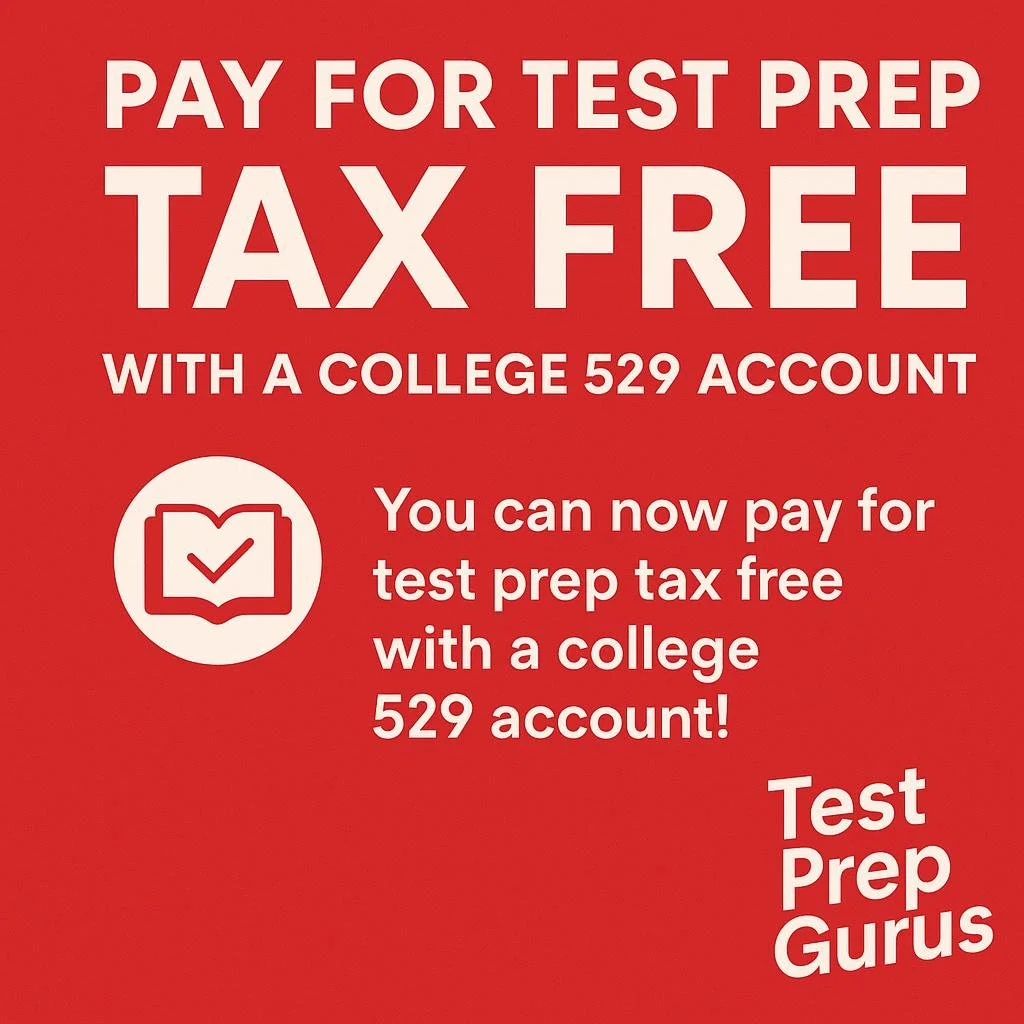
You Can Now Use Your 529 Plan to Pay for Test Prep — And It’s a Big Deal
Families across the country are celebrating a quiet revolution in education policy: You can now use your 529 College Savings Plan to pay for SAT and ACT test prep — tax-free.
At Test Prep Gurus, we’ve helped students earn life-changing scores for over a decade. But this policy change makes elite test prep more financially accessible than ever before.
A 529 plan is a tax-advantaged savings account designed to help families pay for education. These accounts are typically sponsored by individual states.
For years, 529s only covered college tuition, fees, and room and board.
But thanks to recent reforms — including the 2025 Big Beautiful Bill Act — families can now use 529 funds for:
SAT & ACT test prep courses
Tutoring services
Online educational programs
This means your child’s Test Prep Gurus course now qualifies as a tax-free educational expense.
Let’s look at two real-world examples:
🧑🏫 Example 1: One-on-One Prep ($4,500)
A family signs up for 24 hours of private tutoring with senior instructors.
Course cost: $4,500
Tax savings: Depending on your state and tax bracket, you could save $500–$1,800 or more
Bonus: You avoid paying federal tax on investment gains from your 529 account.
🧑💻 Example 2: Virtual Classroom Course ($899)
Another family enrolls in a virtual classroom course with 12 students per class.
Course cost: $899
Tax savings: Between $100–$300, depending on your state
State perk: Some states (like Indiana) offer up to $200 in tax credits for using 529 funds
In both cases, families unlock powerful prep — and get a financial break for doing it the smart way. In other words: You’re getting a major discount on top-tier education just for planning smart.
Test Prep Gurus programs are designed to help students:
Improve SAT scores by a guaranteed 100+ points (our students average gains much higher)
Raise ACT scores by a guaranteed 3+ points (our students average gains much higher)
Unlock $10,000 to $250,000 in merit-based scholarships
Stand out in competitive college admissions
By allowing families to use 529 plans for test prep, this change expands access to meaningful opportunities — no matter your zip code or income level.
This isn’t about privilege. It’s about preparation.
Here’s how to pay for your course with Test Prep Gurus — and get reimbursed tax-free:
Step 1: Enroll
Visit www.prepgurus.com and sign up for an SAT or ACT course or 1-on-1 package.
Step 2: Pay with a Credit Card
Complete checkout as usual. Be sure to save your receipt and confirmation email.
Step 3: Log in to Your 529 Plan Portal
Visit your state’s 529 provider (such as Ascensus, Vanguard, or Fidelity).
Step 4: Request a Reimbursement
Select the option to reimburse yourself for a qualified educational expense. Upload your Test Prep Gurus receipt if requested.
Step 5: Receive Your Tax-Free Funds
You’ll usually get reimbursed to your bank account within a few days.
🔔 Important: Make sure the purchase and reimbursement both occur in the same calendar year to remain compliant.
We’re making it easier than ever to maximize your 529 benefits. Here’s how:
We provide itemized receipts labeled as “standardized test preparation”
Our programs are designed to be 529-eligible under new federal guidelines
Our team is happy to guide you through the reimbursement process if needed
Standardized tests aren’t perfect — but they remain one of the few scalable academic tools that can dramatically expand opportunity.
A high SAT or ACT score can still:
Change a student’s college trajectory
Open the door to scholarships
Help applicants stand out in a competitive process
This policy shift means more students can afford to prepare — and more doors will open as a result.
You’ve saved for your child’s future. Now let’s make the most of it.
Head to https://www.prepgurus.com/contact, choose the right prep course, and use your 529 plan to get reimbursed — tax-free.
It’s a smart investment in your child’s education, college journey, and long-term success.
I talk a lot about growth mindset in education and psychology—and for good reason. The belief that you can improve through effort, feedback, and persistence is one of the most empowering ideas of the modern era. It’s the foundation of deep learning, transformation, and high performance.
I’ve built a career—and a life—around this principle.
But today, I want to explore the other side of the coin. I want to offer a defense of the fixed mindset.
Yes, you read that right.
Because in our rush to celebrate growth, we’ve overlooked the value of certain fixed beliefs—especially those that are earned, chosen, and functional.
In Carol Dweck’s original research, a fixed mindset is the belief that ability is static, talent is innate, and failure is a verdict. Taken to the extreme, this view can stifle growth, discourage risk-taking, and lead to shame when we fall short.
But here’s the thing: we all hold fixed beliefs. About who we are. About what we value. About what we’re willing to fight for.
And some of those beliefs serve us.
“I’m a visual thinker.”
“I’m a leader.”
“I’m someone who follows through.”
These aren’t limitations. They’re earned identities—narratives we’ve built through effort and experience. As Aristotle said, we are what we repeatedly do. Excellence, then, is not an act but a habit.
You can’t wake up every morning rethinking your entire identity. That’s paralyzing. Fixed beliefs give us structure. They help us act decisively, commit to long-term goals, and build lasting relationships.
The danger isn’t in having a fixed mindset. The danger is in clinging to one that’s outdated, fear-based, or untested.
But when fixed beliefs are earned—when they come from lived experience—they become powerful anchors. They allow us to perform under pressure.
When I earned a perfect SAT score in graduate school, I wasn’t trying to prove I was smart. I was testing a hypothesis: could a “fixed” test be beaten with a growth mindset?
Yes—but only because I had a fixed belief that I was a strategic thinker. That belief, built over years of work, gave me confidence. It allowed me to execute like a pro.
When we work with students preparing for standardized tests, the highest performers share a mindset that blends both fixed and growth elements:
“Yes, I’m smart. I can do this.”
“And I’ll keep improving through deliberate effort.”
That’s the sweet spot. That’s where confidence meets humility.
The most successful people I’ve interviewed on The Nick Standlea Show don’t live at the extremes. They have firm convictions about who they are—and flexible strategies about how to improve.
As Zig Ziglar once said, “Be firm in your principles, but flexible in your methods.”
Or as one futurist put it: strong beliefs, loosely held.
That’s not weakness. That’s wisdom.
So here’s the takeaway: A fixed mindset isn’t always a flaw. When it’s based on earned identity and used strategically, it’s a strength. And when paired with a growth mindset, it becomes a foundation for thriving in a fast-changing world.
Know who you are. Stay open to who you’re becoming.
That’s not just good psychology. That’s how you thrive.

If you're about to start the college admissions process, you're not alone.
We recently surveyed parents who just went through it, and they shared valuable insights—what worked, what didn’t, and what they wish they had known earlier.
Uncertainty about how to stand out in a competitive applicant pool
Overwhelming complexity of the college application process
Pressure to start preparing as early as freshman year of high school
Concerns about affording college and navigating financial aid
Worry that not submitting scores could hurt their child’s chances
Waiting until senior year to start the college planning process
Focusing solely on GPA and extracurriculars without considering tests
Trying to control every aspect of the application process for their child
Applying to too many "reach" schools without safety options
Assuming "test-optional" means test scores don’t matter (spoiler: they do)
A clear understanding of how colleges use test scores
Generous financial aid or scholarship offers
An admissions plan with a balanced list of safety, match, and reach schools
Confidence in making the right decision about test prep and score submission
Child takes ownership of the process while parents provide support
At Test Prep Gurus, we help families navigate this process with clarity and confidence. Your child should have every opportunity to stand out—whether that means submitting test scores or crafting a compelling application without them.
If you're ready to take the guesswork out of college admissions, let’s talk. Schedule a free consultation today.
At Test Prep Gurus we teach students how to raise their grades and scores on the ACT, SAT, ISEE, HSPT, APs so they can reach their goals for college and beyond.
It all starts with 3 steps:
Complete practice exams.
Schedule a free 15-minute consultation to review your exam results.
Create a 1-on-1 test prep plan to reach your goals for college and beyond.